Abstract
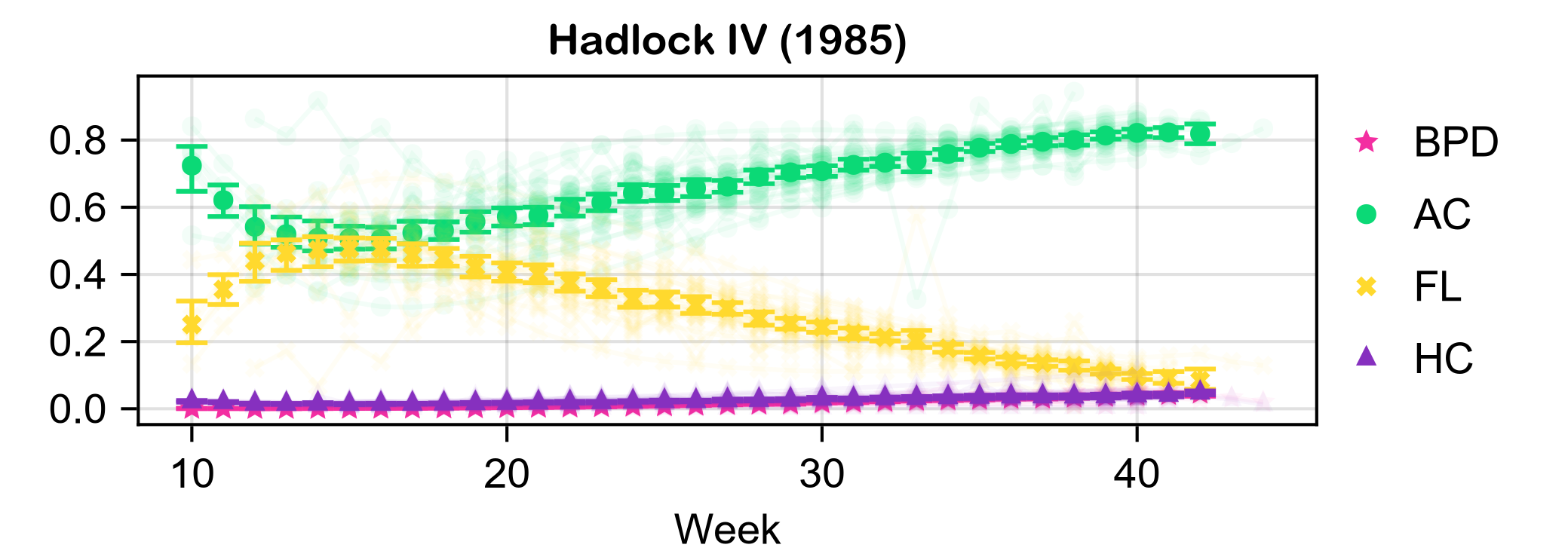
Accurate assessment of estimated fetal weight (EFW) is crucial in obstetrics, yet the exact contribution of biometric parameters in sonographic formulas remains unclear. Twenty-six datasets from published studies spanning diverse populations and gestational ages were analysed, incorporating measurements of biparietal diameter (BPD), abdominal circumference (AC), head circumference (HC) and femur length (FL). Sobol’ global sensitivity analysis—a variance‑based approach—quantified each parameter’s influence on EFW across 29 established formulas, and bootstrapping estimated the median of the sensitivity indices with 95% confidence intervals. Results showed that AC was generally the dominant predictor, especially in later pregnancy, while BPD, HC and FL exhibited variable importance depending on formula and gestational age. Two-thirds of the formulas demonstrated parameter crossover effects, and nearly half had at least one parameter with minimal contribution. These findings indicate that parameter significance differs by both formula and gestational age, suggesting that clinicians should select EFW formulas based on gestational age, measurement reliability and fetal characteristics. Estimates made with fewer than the intended parameters can be viable in emergencies. The proposed methodology can guide the refinement of existing formulas and the development of improved fetal weight estimation models.
BibTex
@article{2025_dependence_fetalweightestimation,
 abstract = {Accurate assessment of estimated fetal weight (EFW) is crucial in obstetrics, yet the exact contribution of biometric parameters in sonographic formulas remains unclear. Twenty-six datasets from published studies spanning diverse populations and gestational ages were analysed, incorporating measurements of biparietal diameter (BPD), abdominal circumference (AC), head circumference (HC) and femur length (FL). Sobol’ global sensitivity analysis—a variance‑based approach—quantified each parameter’s influence on EFW across 29 established formulas, and bootstrapping estimated the median of the sensitivity indices with 95% confidence intervals. Results showed that AC was generally the dominant predictor, especially in later pregnancy, while BPD, HC and FL exhibited variable importance depending on formula and gestational age. Two-thirds of the formulas demonstrated parameter crossover effects, and nearly half had at least one parameter with minimal contribution. These findings indicate that parameter significance differs by both formula and gestational age, suggesting that clinicians should select EFW formulas based on gestational age, measurement reliability and fetal characteristics. Estimates made with fewer than the intended parameters can be viable in emergencies. The proposed methodology can guide the refinement of existing formulas and the development of improved fetal weight estimation models.},
 author = {Bitsouni, Vasiliki and Gialelis, Nikolaos and Tsilidis, Vasilis},
 code = {https://github.com/TsilidisV/DopEFW.jl},
 doi = {10.1098/rsos.250172},
 journal = {Royal Society Open Science},
 number = {6},
 pages = {250172},
 publisher = {The Royal Society},
 title = {Partial dependence of ultrasonically estimated fetal weight on biometric parameters},
 volume = {12},
 year = {2025}
}